Cloud-based genomics pipelines for ophthalmology: Reviewed from research to clinical practice
This review article describes the potentil of cloud computing to enable the clinical use of genomic data in eye care. For decades, researchers have been anticipating genomics to revolutionize clinical practice, since identifying the genetic bases of diseases could greatly help in predicting and treating them. However, most of the research focuses on identifying links between genetic variants and diseases without providing any guidelines on how to apply it to clinical practice.
Many eye diseases, and specially inherited eye diseases, have a genetic basis, and recent advances in sequencing technology and the completion of the Human Genome Project would enable the use of genomics in eye hospitals. Nonetheless, genomic testing is mostly done in specialist labs, with the required infrastructure and expertise, and not in hospitals because of the large size and complexity of sequencing data which makes analysis difficult in traditional hospital settings.
Cloud-based pipelines address this by providing scalable computing power, faster processing, and easier data sharing across institutions. A cloud-based solution could implement the data processing steps of a genomics pipeline, mainly sequence alignment, variant calling and annotation and interpretation, which require massive computation and storage, at a size of several tens of GB per patient. Additionally, the cloud offers a scalable way to exchange sensitive data between hospitals.
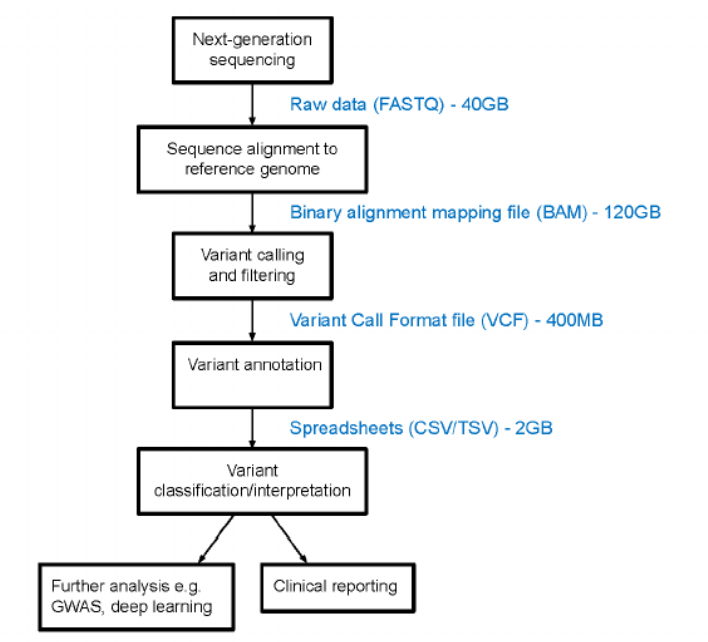 Fig. 1: Genomic pipeline.
The authors propose a workflow in which patient genomic data is analyzed in the cloud and integrated into clinical systems to support diagnosis and personalized treatment.
While the approach offers significant benefits in accessibility, challenges still remain. For example privacy, although providers like AWS and GCP already comply with strict security standards, the right to data erasure, which must be ensured especially when the data is stored in the cloud, and complex pricing models and unexpected costs.
In the future, cloud computing could allow genomic pipelines in non-specialist hospitals as well as global collaboration across hospitals, and is an essential tool for making large-scale genomic analysis practical, scalable, and clinically usable in ophthalmology.
Reference
Wong, David & Olivera, Maximiliano & Yu, Jing & Szabo, Anita & Moghul, Ismail & Balaskas, Konstantinos & Luben, Robert & Khawaja, Anthony & Pontikos, Nikolas & Keane, Pearse. (2021). Cloud-based genomics pipelines for ophthalmology: Reviewed from research to clinical practice. Modeling and Artificial Intelligence in Ophthalmology. 3. 101-140. 10.35119/maio.v3i1.115.